
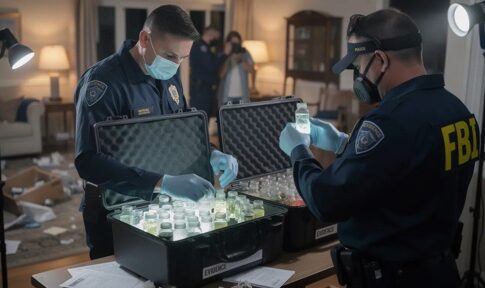
The essential issue is not whether the DEA has ever made large fentanyl seizures; it is whether, in at least some New Mexico cases, the agency tolerated dangerous drugs on the street as an enforcement tactic, then defended that choice as ordinary tradecraft. If the whistleblower account is substantially right, the implications extend far beyond one state: they go to the boundary between intelligence-gathering and public endangerment, and to whether civil and criminal accountability can attach when federal drug strategy collides with a lethal market.
Intro Header
- The dispute turns on a specific enforcement method: allowing a controlled drug delivery to proceed in order to develop a larger trafficking case.
- AP’s reporting, backed by current and former DEA agents and government records, describes that tactic in New Mexico and cites a 74,000-pill delivery that was monitored but not seized.[1][4]
- DEA denies that it knowingly let fentanyl reach communities and says its decisions were lawful and consistent with Department guidance.[4][10]
- New Mexico’s governor has turned the issue into a formal state-level challenge, asking the attorney general to examine possible violations of state law.[1][3]
Why this allegation is so explosive
Drug enforcement agencies have always walked a hard line between disruption and intelligence collection. In narcotics work, a “controlled delivery” is not exotic by itself; investigators sometimes watch a load move so they can identify the suppliers, couriers, financiers, and downstream network. What makes the New Mexico case combustible is the substance involved. Fentanyl is not marijuana, and counterfeit pills containing fentanyl are dangerous in trivial quantities; the margin for “we were watching” is extremely thin when the watched product can kill quickly and unpredictably. That is why the allegation has landed as a moral and operational indictment, not just a procedural complaint.[18][21]
The AP reporting says the DEA allowed hundreds of thousands of fentanyl pills to reach New Mexico between 2023 and 2025 while pursuing larger trafficking cases, based on three current and former DEA agents and government records. The most concrete example described in the coverage is a June 2023 delivery at an Albuquerque mobile home park, where agents reportedly intercepted coded calls, documented the drop, and recorded 74,000 pills without immediate seizure. That is the kind of fact pattern that gives the story its force: not a generalized suspicion, but an operational choice attached to a traceable incident.[1][4][7][10]
How the alleged tactic works, and why prosecutors like it
The logic of the tactic is straightforward. If agents seize a load too early, they may recover drugs and arrest a courier, but miss the broader architecture of the trafficking network. If they let the load move, they may be able to identify higher-level organizers, communications nodes, stash houses, and money flows. In the abstract, that can be rational, even effective. The DEA has long emphasized broad disruption and multi-agency task-force work in Albuquerque, where it maintains a local presence and active enforcement footprint. Federal drug enforcement also continues to produce major fentanyl seizures nationally, which reinforces the agency’s view that aggressive network targeting remains necessary.[7][17][23]
That is the strongest version of the government’s defense. Former U.S. Attorney Alex Uballez told AP that drugs sometimes went unseized because his office had limited resources and because prosecuting larger organizations can have more impact than intercepting every suspected transaction. DEA spokeswoman Amanda Wozniak separately said the investigative decisions were “lawful, reasonable under the circumstances and consistent with Department guidance,” and the agency requested an internal watchdog review. In other words, the agency’s case is not that nothing happened; it is that the choices were a legitimate use of prosecutorial discretion under difficult conditions.[4][7][8][9][10]
Where the legal and ethical fault line actually runs
The fault line is not whether law enforcement may ever use controlled deliveries. It is whether a tactic that predictably leaves lethal fentanyl in circulation crosses from calculated investigation into reckless indifference, especially if agents had probable cause and the ability to seize. The research package points to 2019 DOJ fentanyl protocols that emphasize public safety, and it says the whistleblower complaint argues the New Mexico operation violated those protocols. That makes the case more than a public-relations dispute; it becomes a question of whether internal guidance was treated as binding or as flexible enough to justify leaving street-level danger in place.[2][4]
Here the evidentiary shape matters. There is, so far, no publicly released internal memo, transcript, or wiretap order that flatly proves a written “stand down” command. The allegation rests on whistleblower testimony, corroboration from other agents, and records reviewed by AP. That is substantial, but it is not the same thing as a documentary smoking gun. The absence of a released order also gives DEA room to insist that it was following lawful procedure rather than intentionally exposing the public to harm. The dispute therefore remains serious, but not yet fully adjudicated.[2][4]
The 74,000-pill Albuquerque incident is important because it narrows the argument from abstraction to conduct. If agents watched a delivery unfold and recorded it in internal reporting, then the remaining question is not whether they knew, but why they did not act. AP’s coverage says federal prosecutors later confirmed the figure in a court filing, which makes the incident harder to dismiss as rumor or exaggeration. Still, confirmation of the quantity is not the same as proof that every legal condition for seizure was satisfied or ignored. The government can still argue operational necessity; critics can still argue the tactic was indefensible. Both claims can coexist until the underlying files are made public.[5][7][9]
New Mexico governor says state could seek billions after DEA let fentanyl hit streets https://t.co/U3AVEX8UZ8 via @@YahooNews
— Panama Rock Radio (@panamarhradio) June 29, 2026
Why New Mexico has turned this into a liability question
Governor Michelle Lujan Grisham has not treated the issue as an internal DEA debate. She has asked the state attorney general to investigate whether federal agents broke New Mexico law, and she has framed the conduct as something that could justify substantial damages. That move matters because it shifts the argument from federal policy to state injury. Once the state characterizes the conduct as actionable harm, the conversation stops being solely about drug interdiction and becomes one about public health loss, civil exposure, and institutional accountability.[1][3]
The governor has also tied the allegation to overdose trends, citing New Mexico Department of Health data showing a 21% increase in overdose deaths from 2024 to 2025 while national deaths declined. That statistic is politically potent because it gives the complaint a human ledger. But correlation is not causation, and the package does not supply the kind of forensic comparison that would prove the unseized pills drove the increase. What it does establish is enough to keep the issue alive: a state already battered by fentanyl now says federal agents may have worsened the danger for investigative gain.[1][4][9]
What would settle the case, and what will not
Public debate will not be settled by denunciations from either side. It will be settled, if at all, by the paper trail: wiretap applications, surveillance logs, prosecutorial instructions, internal compliance reviews, and Inspector General findings. Those are the documents that can reveal whether the tactic was a narrow, defensible controlled delivery or a broader practice of tolerating street-level fentanyl to build “bigger cases.” The DEA’s own request for a watchdog investigation suggests it understands that general denial is not enough to close the matter.[10][16]
There is also a broader institutional lesson here. Federal drug enforcement has spent years advertising its scale, and rightly so; the agency seizes enormous quantities of counterfeit pills and fentanyl powder every year. But scale cuts both ways. The larger and more sophisticated the interdiction apparatus becomes, the more tempting it is to rationalize losses at the margins as the price of bigger wins. When the drug in question is fentanyl, those margins are no longer bureaucratic trivia. They are the difference between a successful takedown and a body count that cannot be reversed.[17][18][23]
Sources:
[1] Web – New Mexico governor says state could seek billions after DEA let …
[2] Web – Governor issues statement on DEA’s failure to seize thousands of …
[3] Web – Feds allowed millions of fentanyl pills to ‘walk’ on New Mexico …
[4] Web – New Mexico governor calls for criminal probe of DEA allowing …
[5] Web – Staggering amounts of fentanyl hit streets as DEA watched … – PBS
[7] Web – [PDF] United States Department of State Bureau for International …
[8] Web – Albuquerque | DEA.gov
[9] Web – A federal jury convicted an Albuquerque man for his role … – …
[10] Web – Opioid Safety & Overdose Prevention
[16] Web – DEA asks watchdog to investigate claims that agents permitted …
[17] Web – DEA’s OD Justice Devotes Critical Resources to Fatal Drug …
[18] Web – Largest Fentanyl Bust in DEA History: Authorities Seize Over 400 …
[21] Web – Canada’s Fentanyl Czar – Privy Council Office
[23] Web – In 2026, the men and women of DEA Los Angeles will continue to …